
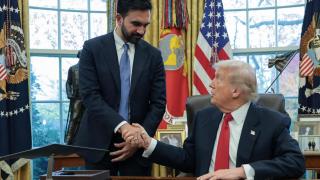

Donald Trump has found in the Muslim Brotherhood an enemy for a new problem: his smiling photo with the first Muslim mayor of New York, the socialist Zohran Mamdani in the Oval Office.
Three days after that meeting, on November 24, the White House announced an executive order which opens the process to declare various branches of the Muslim Brotherhood as a foreign terrorist organization.
The temporal coincidence illuminates the intersection between American domestic politics and Middle Eastern geopolitics.
The Muslim Brotherhood was born in Egypt in 1928, founded by the Egyptian Islamist Hassan al-Banna as an Islamic movement of religious and social reform against colonialism and secular elites, with the idea that Islam is a total system of life and Sharia (Islamic law) should also govern politics.
Since the mid-20th century, they have expanded throughout the Arab world through mosques, schools, unions, charity associations and, later, parties, becoming a large transnational network with strong social roots.
From the beginning two lines coexist: one nonviolentfocused on preaching, social work and electoral participation (as a loyal opposition in Jordan, a parliamentary force in Egypt before 2013 or inspiring parties such as Ennahda in Tunisia); and another militantlinked to the special apparatus responsible for attacks in Egypt and, after the president’s repression social Nasser’s prazeto the development of more radical currents associated with the Egyptian theorist Sayyid Qutbfrom which groups such as the Egyptian Islamic Jihad, al-Gamaa al-Islamiya and cadres will emerge that will converge into Al Qaeda.
He Salafism and Wahhabismalthough they do not come from the Brotherhood, they are previous and autonomous currents with which the movement intersects throughout the 20th century, and are the ideological substrate of the jihadist salafism of Al-Qaeda and ISIS (Islamic State).
In Palestine, its local branch crystallizes in Hamaswhich in 1988 was defined as an arm of the Brotherhood, combining government in Gaza and armed struggle against Israel. Today the Brotherhood is less a unitary organization than a constellation of branches: some integrated into political systems as legal and non-violent Islam, and others banned and labeled as terrorists (Egypt, Saudi Arabia, Emirates), with pockets where the border between political activism and support for armed groups, such as Hamas, remains a matter of dispute.
Returning to Washington and according to the reconstruction published by Politicothe meeting with Mamdani unleashed a wave of anger among part of the Trumpist base: commentators such as far-right activist Laura Loomer and other figures in the MAGA (Make America Great Again) ecosystem had been presenting the New York politician as “radical islamist” for their positions against Israel.
Trump, on the other hand, refused in public to call him a “jihadist” and displayed an institutional cordiality that disconcerted that sector. Seventy-two hours later, the order against the Muslim Brotherhood arrived, interpreted as an attempt to throw a bone to chew on the indignant.
It is worth remembering that the crusade against the Brotherhood did not begin with Mamdani. Since his first term, Trump has received pressure to designate it as a terrorist organization, both from Congress—with Republican Party heavyweights such as Ted Cruz, Tom Cotton and Elise Stefanik—and from allied and anti-Brotherhood governments in the region, starting with Egypt, Saudi Arabia and the United Arab Emirates.
The attacks of October 7, 2023 by Hamas – remember, wing of the Brotherhood in Palestine – and Israel’s subsequent war in Gaza reactivated that debate.
The signed order It is not a designationbut begins a process to consider it as a Foreign Terrorist Organization (Foreign Terrorist OrganizationsFTO) and Specially Designated Global Terrorist (SDGT) to specific chapters of the movement in Egypt, Jordan and Lebanon. The Secretary of State and the Secretary of the Treasury must deliver a joint report within 30 days, and the administration has 45 days to act.
In practice, this opens the door to freezing assets, prohibiting entry into the United States and criminally prosecuting leaders of the Islamic movement. Part of the Trumpist right has received the announcement with nuanced enthusiasm: it criticizes the fact that the branches in Qatar and Türkiyewhose leaders also maintain excellent relations with Trump.
Although Ankara has not officially reacted, newspapers such as Republic They emphasize that the measure “may open a new source of tension on the Ankara-Washington line.” The former spokesperson of the government party AKP (Justice and Development Party) Ömer Çelik already announced in 2019 that this eventual designation could be a serious development that would encourage the resurgence of groups such as ISIS and hinder the fragile democratic process in some countries in the region.
The response has been similar in Qatar, where local analysts see it as a veiled warning against Doha and its pro-Gaza ecosystem. But the ad has clear limits in factsuch as the fact that the White House has agreed to support the former Al-Qaeda jihadist Ahmed al-Sharaa at the head of Syria one year after coming to power after overthrowing the bloody regime of Bashar al-Assad. The Islamist has recognized ideological links with the Brotherhood.
The choice of this middle path is not accidental. Daniel Bymanan expert on Middle East terrorism at Georgetown University, has been emphasizing for years that the Brotherhood is not a monolithic actor, but a umbrella under which very different realities coexist depending on the country: from groups that have turned to armed violence to legal Islamist oppositions that compete in elections or manage social work. Treating it as a single centralized organization, he claims, is false in empirical terms and fragile in legal terms.
Other experts, such as Michael Jacobson y Matthew Levittdel Washington Institute, they published just a few days before, on November 18, a document titled “A more effective approach to countering the Muslim Brotherhood”, where they defend a strategy of concentrating on specific branches and financial nodes.
The article maintains that, after the anti-Semitic Boulder arson attack (June 1) attributed to a Muslim Brotherhood sympathizer and amid pressure from Congress to designate the entire movement as a terrorist organization, the Trump administration should renounce a global and indiscriminate label—legally and politically unviable for a network without a single command—and opt for a “surgical” strategy.
This would be using the figure of SDGT against entities in the Brotherhood’s orbit that finance Hamas (such as the Union of Goodthe Federation of Islamic Organizations in Europe or the Popular Conference for Palestinians Abroadin addition to several “fake NGOs” spread across Europe, the Middle East and Africa.
It would also be to reserve the designation of FTO only for branches that have already crossed the line of violence (such as the Jordanian chapter involved in terrorist plots or the Lebanese al-Jamaa al-Islamiyah and its al-Fajr Forces, coordinated with Hezbollah), following the precedent of the Egyptian splinter groups designated in Trump’s first term, because only in this way—based on solid evidence and concrete cases—will it be able to effectively hit the financing of Hamas, dissuade other branches from resorting to violence and convince allies, especially Europeans, to join in sanctions and legal actions.
In fact, Levitt, who like Jacobson is a former senior counterterrorism official in the US security apparatus, publicly opined on LinkedIn that Trump has copied their idea.
In the Middle East, this executive order consolidates a line of fracture: on the one hand, the anti-Brotherhood axis formed by Egypt, Saudi Arabia and the Emirates; on the other, the Türkiye-Qatar axis.
In Egyptthe practical impact is limited. Abdel Fattah al-Sisi’s regime waged its own all-out war against the Muslim Brotherhood following its 2013 military coup. Jordanthe movement has had its own party, parliamentary presence and ministers in successive governments, being treated as a loyal opposition.
The analysis of Zvi Bar’el in the diary Haaretz insists that neither Egypt nor Jordan have ever needed a US presidential order to repress the Muslim Brotherhood.
Türkiye offers a particularly complex case. The AKP of Recep Tayyip Erdogan It is practically a branch of the Brotherhood and shares roots in political Islam. After al-Sisi’s coup, Ankara welcomed hundreds of Egyptian cadres into its territory and also shelters Hamas militants and leaders.
Qatarfor its part, is the most obvious financial and diplomatic pillar. For years it has financed projects linked to the movement and has offered media coverage through its propaganda organ, the network Al Jazeera.
Beyond the capitals, the decree impacts how the category of “terrorism” is constructed. Al Jazeera denounces that the term is used as a political label.
Nathan Browna specialist in Arab politics at George Washington University, has drawn attention to the negative consequences that this executive order may have for refugees, exiles and diasporas.
All this occurs in the midst of the volatility of the ceasefire between Israel and Hamas. The order reinforces the thesis that there is no significant difference between Hamas, the Brotherhood and other Islamist actors. The order was born in part to correct an uncomfortable image among the base, but it will unfold its effects in Cairo, Amman, Istanbul or Doha.